





























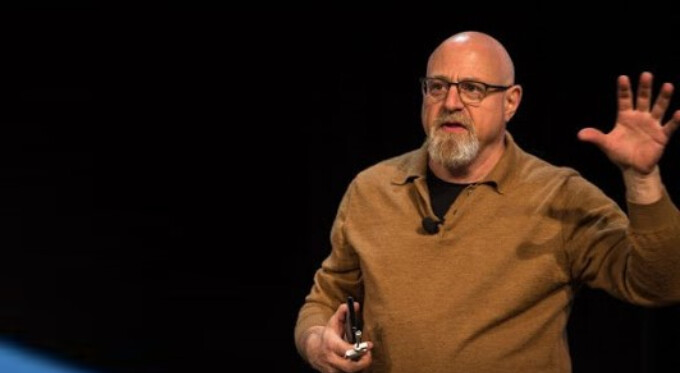
 Charlie Fink is a leading authority on the Metaverse, renowned for his deep expertise in immersive technologies and the future of digital interaction. With an impressive four-decade career spanning Disney, AOL Studios and beyond, Charlie has firmly established himself at the intersection of popular culture and emerging tech.
As a weekly columnist for Forbes, co-host of the This Week in XR podcast and a faculty member at Chapman University, Charlie is a respected voice in the XR space. He is also a sought-after speaker with The Champions Speakers Agency, sharing insights at high-profile events including CES and South by Southwest.
In this interview, Charlie discusses how businesses can prepare for and adapt to a 3D internet, the role of immersive technology in commerce, and why timing, not hype, is the real question when it comes to the Metaverse.
Q: What does your role as a Metaverse consultant involve?
Charlie Fink: “Primarily, I’m a college professor. Right now, I’m teaching full-time, and I talk about virtual and augmented reality, and the Metaverse. I’ve written several books, I write a weekly column for Forbes, and an accompanying podcast. From time to time, I work for some of the companies in that category, primarily.
Although, for the past year, I’ve been talking to a lot of commercial enterprises about the Metaverse – what it is, how it affects them, and what strategies they might adopt. While experimenting and anticipating, as all of us do, a very different kind of internet – a 3D internet.
But it’s going to take a long time to manifest, just as immersive technologies like VR and AR are now. Making near-term projections is foolish. I don’t know what Apple is thinking, for example, about launching its headset, but I do know what the end state is going to be.
The real question is timing, because as we all know, our computers are getting smaller. High-speed computing, latency-free computing, is all around us. I think the future is going to be kind of amazing. I hope I’m around to see it.”
Q: In what ways can businesses use data science to improve performance?
Charlie Fink: “This is a question that is outside of my area of expertise. It has to do with the digital transformation of the enterprise. Digital transformation can encompass a lot of things, including data and analysis, and people using that data to train AI and use machine learning to make the data gathering smarter and more useful. But that is a small part of what a company needs to do to transform itself into a digital-first enterprise.
I think many, many mundane, day-to-day businesses now see that that’s what they should do. But how to get there – again, building the aeroplane while flying it – nobody wants to waste time and money. They want to do the thing right. And the truth is, it’s maybe a little bit early to really know what’s going to happen with 3D and the internet.
I don’t think people lost anything in 1994 by not having an email address, even though they thought they did. But of course, again, four years later, it’s true – you had to have one.”
Q: What would you say to companies that aren’t yet investing in digital technologies?
Charlie Fink: “Well, there are two cuts at this, right? One is the Metaverse and immersive technologies, and the other one is digital transformation.
I think every company needs to be, if they are not or they haven’t already done it, engaged with its digital transformation to run most efficiently and to be compatible with what everybody else is doing.
On the Metaverse side, I think it’s very early. And for a smaller enterprise, I think it is too early. For a big enterprise like Deloitte, it’s absolutely necessary, that’s forward-looking to them. They have to have strong in-house expertise to support that business imperative or marketing imperative from their clients. And their clients are the biggest companies in the world.
Build things and experiment. Walmart just launched a giant thing on Roblox, and they have no idea if that’s going to work—but it’s better than advertising on TV today.”
Q: How do you see the Metaverse being used by businesses in future?
Charlie Fink: “Well, everything that we do today in the physical world, we will do in the Metaverse in the future.
Let’s take our friend Walmart. You could, using a video game controller, have an avatar on your 2D screen that you can guide through a 3D world. You could do it in VR and be first-person, or you can play it like a third-person video game and use your avatar to walk through the aisles of stores or a big gallery and choose clothing and buy other commodities that are then delivered to you.
So, it is taking something we’re already doing today on Amazon and making it much better and bigger and more interesting. Will it apply to all categories of all products? Of course not. This is really a question about: what is your business and who is your customer?
But I do think, certainly for consumer product companies and for retail companies most of all, they’re going to continue to see this transformation of things that are physical into things that are digital. They exist as companions for a long time, but eventually – in my view – digital wins, because people will gravitate to things that are easier and cheaper.
I think that you may walk into a mall in the future and be surrounded by a giant magic mirror, and whatever you try on and like, you see applied to your body in real time. And then when you get home, the bespoke garment is waiting for you.
I think that’s the kind of thing, that’s the kind of science fiction future I hope to see in the next 10-20 years.”
This exclusive interview with Charlie Fink was conducted by Mark Matthews, Senior Keynote Speaker and Entertainment Manager.