



























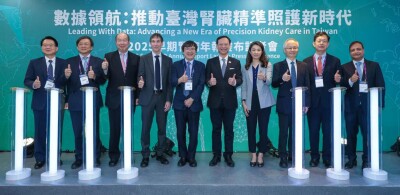

- Yung-Ho Hsu, Secretary General of the Taiwan Society of Nephrology
- Shang-Jyh Hwang, Honorary President of the Taiwan Society of Nephrology
- Masaomi Nangaku, Immediate Past-President of the International Society of Nephrology
- Marcello Tonelli, President of the International Society of Nephrology
- Mai-Szu Wu, President of the Taiwan Society of Nephrology
- Chung-Liang Shih, Minister of the Ministry of Health and Welfare
- Ching-Fen Shen, Director General of the Health Promotion Administration, Ministry of Health and Welfare
- Chih-Cheng Hsu, Professor at the National Health Research Institutes
- Hyeong-Cheon Park, President Elect of the Asia Pacific Society of Nephrology
- Rajnish Mehrotra, President of the International Society of Peritoneal Dialysis
The complete and immediate analysis aids in reversing the past trend where most patients were diagnosed at late stages and required dialysis, ushering in a new era of early detection and treatment. Minister of Health and Welfare, Chung-Liang Shih, stated at a press conference that this annual report serves as a new engine for promoting precise care, integrating complete data and risk classification indicators for Early CKD P4P(Pay for Performance) and Pre-ESRD P4P. This fills the gap in early kidney disease data and strengthens the quantitative basis for policy and clinical decision-making, facilitating early intervention and delaying disease progression. The goal is to achieve the Healthy Taiwan Policy target of reducing the standardized mortality rate for chronic diseases by one-third by 2030, and for Taiwan’s care model to become an example in the Asia-Pacific, establishing a sustainable and precise new framework for kidney care.
The early kidney disease annual report reveals several key trends. According to KDIGO risk classification, the proportion of high-risk and very high-risk patients in the P4P program has gradually decreased in recent years, reflecting a shift in treatment strategies toward early intervention and prevention. This trend not only highlights the medical team’s emphasis on the care of early-stage chronic kidney disease patients but also helps delay disease progression and reduce the incidence of later-stage complications. In terms of controlling the “three highs” (hyperglycemia, hypertension, and hyperlipidemia), data shows that approximately 80% of patients meet lipid targets and nearly 60% maintain stable blood sugar levels. However, only about 30% meet the target for blood pressure below 130/80 mmHg, indicating significant challenges remain in blood pressure control. The “three highs” are important risk factors for the progression and deterioration of chronic kidney disease, making it crucial to further improve control rates. The implementation of the P4P program has already shown preliminary results, and there are expectations for more immediate, comprehensive, and rigorous data collection and tracking, which will more fully demonstrate the long-term benefits of this care model.
Data-Driven: Taiwan’s First Early Kidney Disease Annual Report Fills Care Gaps
Professor Chih-Cheng Hsu from the National Health Research Institutes pointed out that past domestic kidney disease care has primarily focused on dialysis and end-stage disease, with limited understanding of early stages and delayed updates on data. This annual report breaks through traditional reporting frameworks and represents the first integration of complete data and risk classification indicators for Early CKD P4P and Pre-ESRD P4P. Utilizing big data for in-depth analysis, it outlines the disease progression and comorbidity trends of patients at different risk levels, successfully filling the long-term gap in early kidney disease care. He noted that grasping information on early stages of disease helps clinicians intervene earlier and delay deterioration while providing quantitative evidence for health policies to promote proactive and timely kidney care strategies, enhancing Taiwan’s international competitiveness in precise health governance.
Early CKD P4P and Pre-ESRD P4P are two phased quality-based reimbursement programs promoted by the National Health Insurance Administration, addressing key care needs for early chronic kidney disease and pre-dialysis patients, respectively. Early CKD P4P primarily targets patients in CKD stages 1-3a, aiding healthcare institutions in early identification of kidney deterioration risks through disease tracking and integrated care models, providing personalized management. Pre-ESRD P4P focuses on patients in CKD stages 3b, 4-5, enhancing control of complications, medication, and nutritional management while utilizing data feedback to support treatment decisions, aiming to delay dialysis and improve care efficiency. Both programs link the complete processes from early prevention to pre-dialysis intervention, contributing to improved overall CKD care quality and patient long-term prognosis.
Precise Kidney Care: Holistic and Continuous CKD Care as a Model for Chronic Disease
Taiwan centers its approach on “precise care,” continuously optimizing the integrated chronic kidney disease care system to implement policy blueprints in clinical practice. Director General of National Health Insurance Administration, Lian-Yu Chen, mentioned that Taiwan has progressively refined various measures, from educational programs for pre-end-stage renal disease patients to integrated care plans for early chronic kidney disease. The medical team can adjust personalized treatment strategies based on patient risk classification and clinical data, strengthening disease management and follow-up effectiveness for early-stage patients. She indicated that by integrating and providing feedback across units, care gaps could be minimized to ensure that patients receive consistent medical services across different levels of care. Director General of Health Promotion Administration, Ching-Fen Shen, remarked that grassroots health education and community health advocacy go hand in hand to enhance public awareness of kidney health. Years of efforts have significantly slowed the deterioration of early kidney disease progression, with patients participating in integrated care exhibiting a lower future risk of dialysis compared to those who do not participate, showing tangible effectiveness of the Taiwan model.
Policy Linkage and Sustainable Vision: Achieving the Healthy Taiwan Goals and Leading the New Landscape of Asia-Pacific
In response to the government’s “Healthy Taiwan” policy, Taiwan is implementing a preventive kidney care model based on the Early CKD P4P and Pre-ESRD P4P systems and the Early Kidney Disease Annual Report. President of the Taiwan Society of Nephrology, Mai-Szu Wu, stated that investing in early chronic kidney disease management not only contributes to health sustainability but also reduces waste of medical resources, achieving dual benefits of health outcomes and environmental sustainability, assisting the government in its goal to reduce chronic disease mortality by one-third by 2030.
During the Asia-Pacific Nephrology Conference (APCN) held in Taipei this year, the Asia-Pacific’s first Early Kidney Disease Annual Report was officially unveiled. President of the International Society of Nephrology, Marcello Tonelli, and Immediate Past-President , Masaomi Nangaku, along with the President Elect of the Asia Pacific Society of Nephrology Hyeong-Cheon Park and Honorary Secretary Sunita Bavanandan attended as witnesses, attracting experts from South Korea, Japan, Thailand, Malaysia, Australia, New Zealand, Singapore, Hong Kong, Mongolia, Indonesia, and the Philippines. Additionally, various important domestic academic societies, including the Taiwan Academy of Family Medicine, Taiwan Society of Cardiology, the Diabetes Association of the Republic of China (Taiwan), the Taiwan Association of Clinical Diabetes, and the Taiwan Medical Clinics Association also participated and supported the event. Minister Chung-Liang Shih expressed gratitude for the collective efforts and emphasized that this kidney annual report showcases Taiwan’s leading position in medical data integration and clinical evidence, hoping that real-time and comprehensive data analysis will once again showcase Taiwan’s precision care model to the international community, working together with other countries to create a new global framework for chronic kidney disease prevention and treatment.
Hashtag: #TaiwanSocietyofNephrology
The issuer is solely responsible for the content of this announcement.